Neglected Tropical Diseases: Accelerating Progress Towards 2030
November 24, 2026
The World Health Organization (WHO) highlighted progress in access to interventions and in the elimination of neglected tropical diseases (NTDs) in a press release dated 4 November 2026. Fexinidazole, a new treatment for sleeping sickness (human African trypanosomiasis), has reached major regulatory milestones, including a European Union Medicines for all or EU-M4all procedure (formerly named Article 58 procedure) and type II variations, to which Synergy Pharm is proud to have contributed. However, the midterm review of the 2021–2030 roadmap, overseen by a committee of independent experts, shows that the pace of progress remains insufficient to achieve most of the targets.
A few figures on NTDs worldwide and the case of sleeping sickness
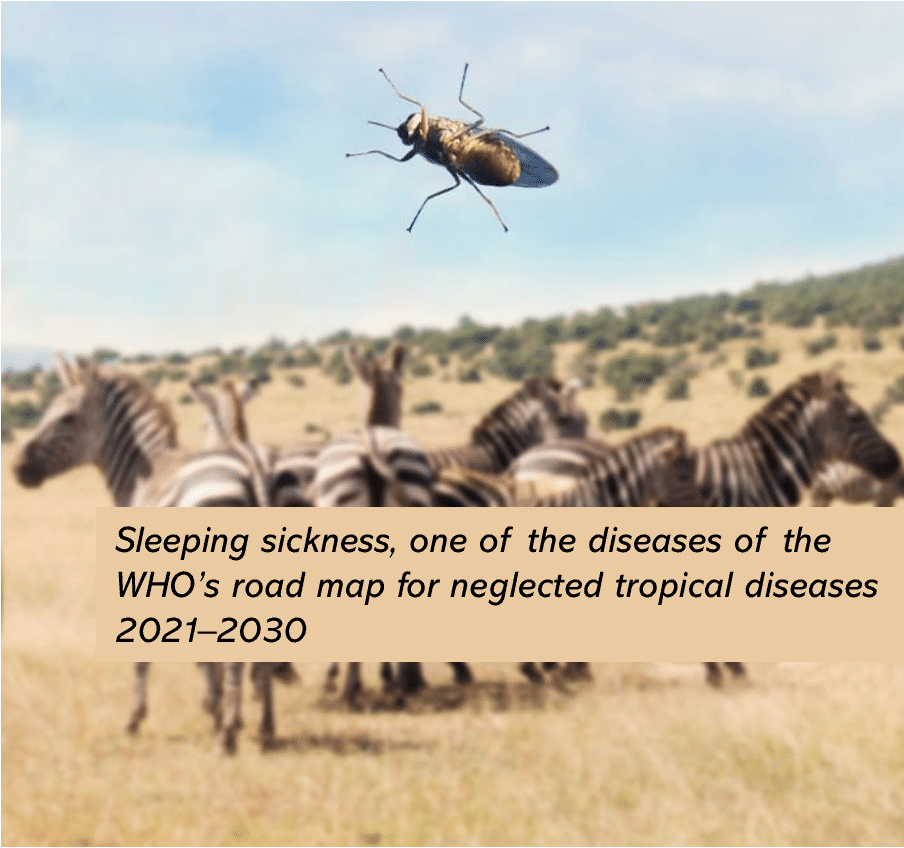
NTDs affect more than one billion people worldwide, particularly those living in poverty, in remote or unstable areas, with little or no access to healthcare services. The WHO NTD roadmap 2021–2030, which follows the 2012–2020 roadmap, covers the prevention, control, elimination and eradication of 21 diseases and disease groups, including noma (gangrenous stomatitis), added in 2023. Elimination of sleeping sickness transmission is among its targets. The disease is caused by a parasite of the genus Trypanosoma brucei (T. b.), transmitted by the tsetse fly. It occurs in two forms: gambiense, found in Central and West Africa, for which humans are the main reservoir; and rhodesiense, found in East Africa, for which livestock and wild animals are the main reservoirs. These two forms accounted for 91% and 9% of cases in 2025, respectively. Without treatment, sleeping sickness is generally fatal.
What are the midterm results of the 2021–2030 NTD roadmap?
The midterm results for the 4 overarching global targets for 2030 of the NTD roadmap show a 19% reduction in the number of people requiring interventions against NTDs (versus a target reduction of 90% relative to 2010). They also show that the reduction in NTD-related disability-adjusted life years (DALYs) has stalled since the 18% decrease observed between 2015 and 2021 (versus a target reduction of 75%). In addition, 63 countries have eliminated at least one disease, against the 100 countries expected by 2030. Finally, eradication of the 2 target diseases, dracunculiasis (Guinea worm disease) and yaws (a chronic bacterial skin infection), requires accelerated efforts to be achieved by 2030. Although these results are encouraging, they remain highly heterogeneous across WHO regions, and even within a single region. For example, Togo has eliminated 4 NTDs, whereas other countries in the African Region struggle to set up effective surveillance systems.
Focus on sleeping sickness
In 2025, 10 countries had eliminated sleeping sickness as a public health problem: 8 for the gambiense form (Côte d’Ivoire, Togo, Benin, Equatorial Guinea, Uganda, Ghana, Chad and Guinea) and 2 for the rhodesiense form (Rwanda and Kenya). Fexinidazole Winthrop® received a positive opinion from the European Medicines Agency (EMA) for the 10-day oral treatment of the gambiense form in 2018 and of the rhodesiense form in 2023. This led to the development of new WHO guidelines for the management of sleeping sickness in 2024. Since the first 2012–2020 roadmap for NTDs, WHO’s collaboration with private and public partners, the development of national plans including vector control, and the implementation of new treatments, including fexinidazole, have contributed to reducing cases to fewer than 1,000 per year for 8 years, reaching a record low of 471 cases in 2025.
What are the risks of failure by 2030?
Five interdependent types of risk have been identified:
- Lack of financial resources;
- Armed conflicts leading to population displacement;
- Climate change, which favors the spread of vector-borne diseases to new areas and degrades water, sanitation and hygiene services during extreme weather events;
- Failure to include NTD interventions in national health systems, leading in particular to weak surveillance and loss of expertise;
- Lack of diagnostic tools for many NTDs and lack of documentation on resistance to available treatments.
What are the prospects for action by 2030?
The midterm review identified several priority measures to implement in 2026–2030, such as:
- Increasing and sustaining national funding plans;
- Taking into account the various environmental changes;
- Integrating surveillance and care into national health systems;
- Funding research programs to advance towards product prequalification before 2030;
- Ensuring equity so that everyone has long-term access to care.
The second half of the WHO’s NTD roadmap 2021–2030 must therefore maintain the gains already achieved and step up efforts to reach all the targets set. Synergy Pharm is also proud to have contributed to the dossier under the EU-M4all procedure, which led to the recent positive opinion granted by the EMA in February 2026 for Acoziborole Winthrop®. Acoziborole is a single-dose oral tablet indicated for the treatment of all stages of the gambiense form of sleeping sickness, which is expected to contribute to the elimination of this disease.