
MedComms Day 2026
June 24, 2026
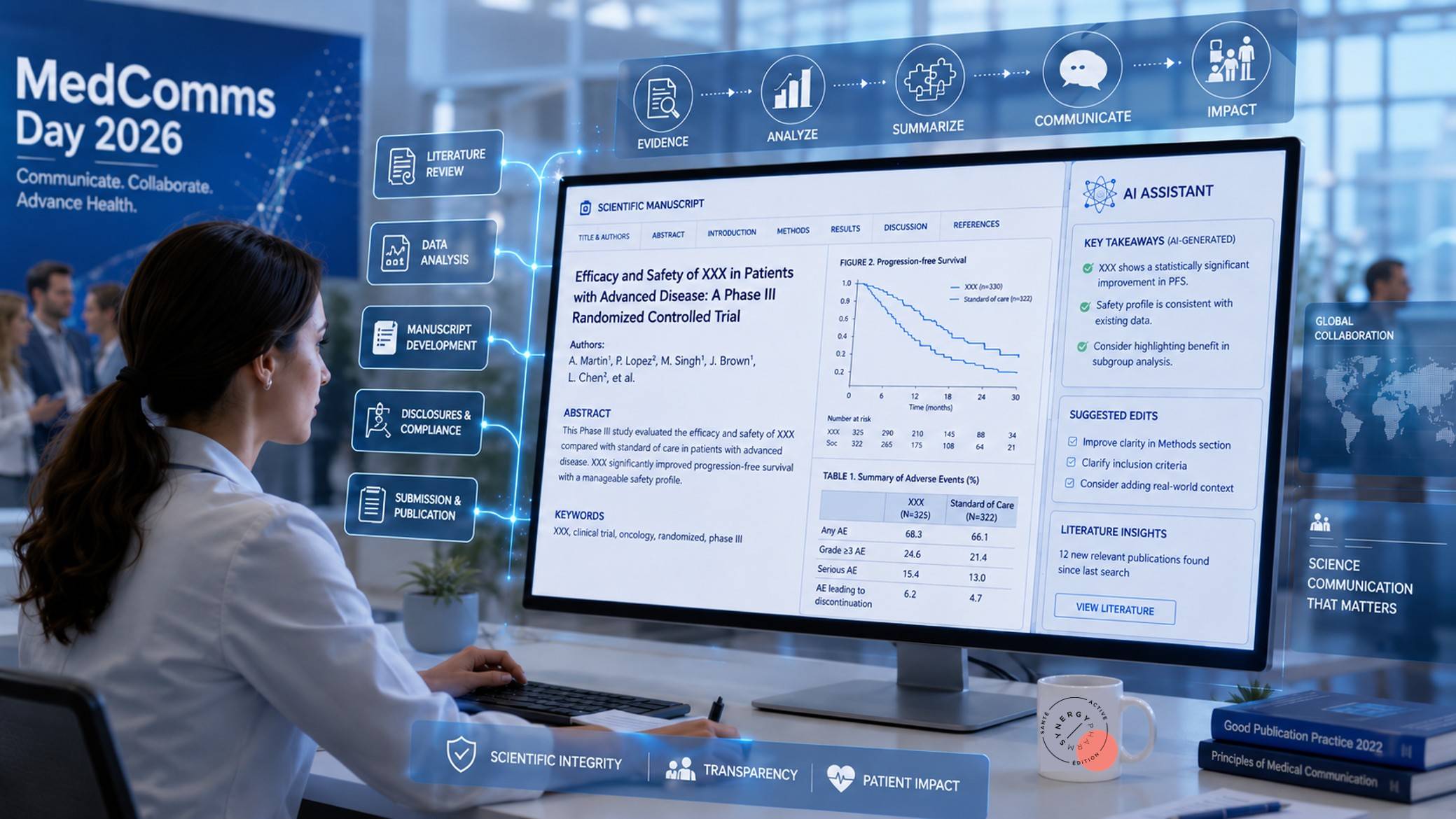
MedComms Day is an annual event celebrated by medical communication professionals worldwide. This year, our team has chosen to explore the use of artificial intelligence (AI) in medical and scientific writing, especially in publications, an area that inspires both optimism and concern.
Use of artificial intelligence in the scientific publication process
The use of AI in scientific publishing is becoming commonplace, but it raises important questions regarding content reliability, confidentiality, transparency, and accountability. While AI can generate compelling text, it may also produce false or biased information, making constant human oversight essential.
2026 Recommendations from the International Committee of Medical Journal Editors
The January 2026 updated version of the Recommendations for the Conduct, Reporting, Editing and Publication of Scholarly Work in Medical Journals developed by the International Committee of Medical Journal Editors (ICMJE) includes a new section related to the use of AI and large language models (LLMs) in publishing and outlines the general principles, responsibilities, and standards applicable to authors, reviewers and editors.
The publication recommendations stipulate that authors can use AI, but must:
- Clearly state how and for what purpose AI has been used
- Verify, correct, and take full responsibility for AI-generated content
- Ensure that no plagiarism is present, including in illustrations
- Never cite AI as an author or primary source.
Reviewers must:
- Comply with the journal’s AI policy
- Not upload manuscripts to unsecure AI tools
- Inform the journal if they use AI and verify the accuracy of AI-assisted evaluations.
And editors of peer-reviewed journals must:
- Ask authors whether AI was used and in what context
- Allow AI use for simple tasks (e.g., spelling, grammar), but carefully assess its use for content generation
- Protect the confidentiality of submitted manuscripts
- Inform authors if the journal itself uses AI (e.g., for abstracts or supplementary content).
Finally, peer-reviewed journals are also expected to establish and clearly communicate their policies on the use of AI.
Failure to disclose the use of AI can be considered as scientific misconduct.
👉 Find out more about the recommendations in the January 2026 ICMJE update: https://www.icmje.org/icmje-recommendations.pdf
Accelerating the Manuscript Review Process with the Use of Artificial Intelligence by Peer-Reviewed Journals
At the end of 2025, an editorial published in The New England Journal of Medicine (NEJM) AI described a new “Fast Track” approach that combines human expertise and AI to accelerate the reviewing process. The approach was applied to the first two articles published in Volume 2 N°12 of NEJM AI:
- A Pragmatic Randomized Controlled Trial of Ambient Artificial Intelligence to Improve Health Practitioner Well-Being
- Ambient AI Scribes in Clinical Practice: A Randomized Trial
The editorial explained how AI was used without replacing human judgment. Articles evaluated via the “Fast Track” process were carefully selected (invited manuscripts, judged to be very promising by several editors, and whose authors had explicitly accepted the use of AI by the journal). After a full review by an editor, the manuscripts were submitted to GPT5 with Thinking (OpenAI) and Gemini 2.5 Pro (Google) for consultative review. GPT5 was also used as an assistant to evaluate technical issues (compliance with the instructions to the authors, and of the research methodology and statistical analysis). The results of the human and AI evaluations were then discussed by the entire editorial team. To ensure transparency, prompts and the human and AI evaluations were published as appendices to the articles accepted through this process.
NEJM AI believes that this first experience was encouraging: the complementarity between human critical evaluation and AI assistance made it possible to speed up the reviewing process, with a first decision reached in 7 days, while maintaining a high level of rigor. AI was found to be effective for verifying statistical and methodological compliance and adherence to journal instructions. However, some AI-generated suggestions were off-topic, highlighting the importance of human expertise and editorial oversight.
The editors intend to extend this rapid evaluation process to submissions across other NEJM journals, on an invitation-only basis, to help cope with the increasing number of manuscripts received. In the case described here, the controlled use of AI as an assistant appears compliant with strict standards; however, concerns remain about the less rigorous use of AI, for example, by other journals that may not guarantee manuscript confidentiality or inform authors of the use of AI in the evaluation process, as recommended by the ICMJE.
Upsurge in fabricated references in biomedical publications: is the use of artificial intelligence to blame?
A growing concern in scientific publishing is the rise of fabricated references. Indeed, a large-scale analysis of 2.5 million biomedical articles published between 2023 and early 2026 identified a worrying increase in this phenomenon. The fabricated citations often appeared credible (i.e., well-formatted, attributed to real researchers, and plausibly dated), but did not correspond to actual publications. In 2023, 1 in 2828 articles contained a fabricated reference, whereas by early 2026 as many as 1 in 277 articles may have been affected. The current estimated rate of fabricated references is therefore approximately 12 times higher than it was three years ago!
According to the authors of this correspondence article published in The Lancet, there are three potential causes:
- Paper mill activity
- Deliberate misconduct
- The non-critical use of generative AI tools: this is likely the major source due to the capacity of these tools to produce realistic but false citations.
At Santé Active Edition – Synergy Pharm, our medical writers are already tackling this issue and systematically check sources when drafting manuscripts and before citing a reference. Checking sources is a major part of the quality control our team carries out on a daily basis. This quality control step is essential as fabricated references can distort the results of systematic reviews and weaken the chain of evidence used to inform medical decision-making.
Artificial intelligence can help, but humans are still essential
AI is developing at high speed and has clear applications in several sectors, including in medical and scientific writing. Nevertheless, its use must comply with certain standards and principles, and, as shown above, caution is still required due to the risk of errors and the introduction of realistic but fabricated content.
When used appropriately as an assistant, AI can save time on certain tasks. However, critically reviewing and checking the accuracy, consistency, and compliance of AI-generated content creates an additional workload that can be at least as time-consuming as the initial writing task. It is therefore unrealistic to assume that AI alone can do the work of a medical and scientific writer, particularly when confidentiality and accountability are required: Humans must remain central to the process, and are ultimately responsible for the content produced.
More generally, the cognitive effort involved in producing content plays a crucial role in how humans retain knowledge and master subjects. Maintaining this effort is essential for brain stimulation, and for preserving cognitive abilities, analytical skills and critical thinking.
Illustration generated using artificial intelligence